
In brief
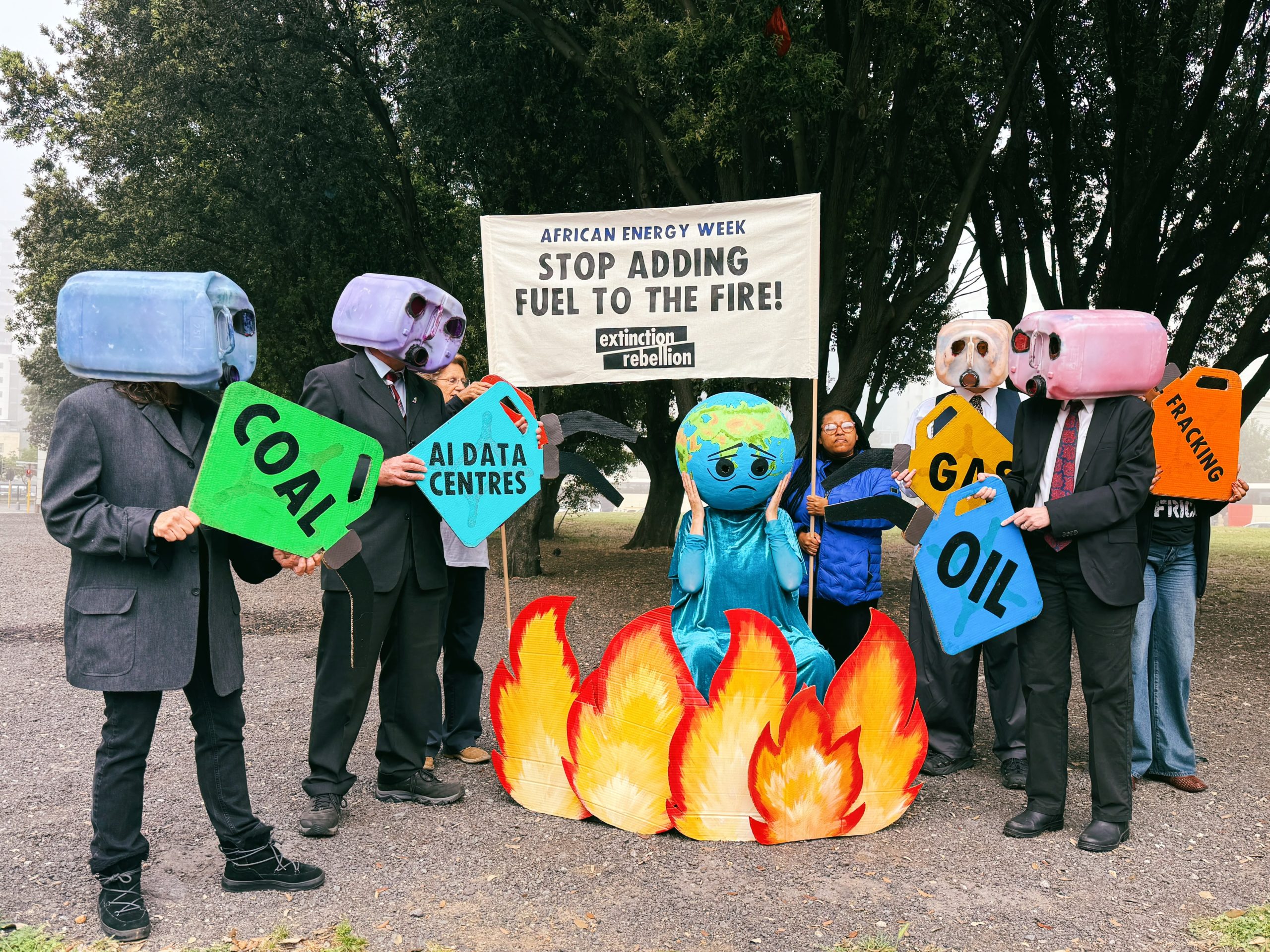
We are here to ask the government to say NO to new sources of fossil fuels. No more coal, oil and gas. No more adding fuel to the fire. No more investing in hell. We demand a clear policy shift to enable a massive rollout of new, sustainable energy sources – to protect our children’s future.
The long version
We are standing outside the Cape Town International Convention Centre on Tuesday 13 October 2026, at the start of the 2026 African Energy Week conference. While there will be delegates here promoting green energy, there will be much hype at this conference about Africa as the new frontier for oil and gas exploration. The talk will be about South Africa getting rich from fossil fuels so that we can have a secure future. We are here to say that such talk is delusional.
There is no secure future on an overheated planet.
We built our civilisation on 10 000 years of a stable climate. Then we found fossil fuels and started to consume them at an ever-accelerating rate. The result is that we are blanketing the planet in greenhouse gases which are trapping the sun’s heat and destabilising the climate. This is the science that is accepted by the scientific community.
We hear it on the news every day – reports of intense droughts, severe floods, melting glaciers, species extinctions, out-of-control wildfires that overwhelm emergency response systems, ocean heat waves, declining agricultural yields, crop failures and people dying from heat-related illnesses. In the short term, food is becoming increasingly expensive which will create social unrest.
In the medium term, famine and migration will cause social upheaval. In the long term, the Arctic and Antarctic ice sheets will melt and the loss of those cooling systems will cause a cascade of warming that no future generation will ever be able to reverse.
In 2015, 200 nations came together and signed the Paris Agreement. The treaty required the signatory countries to steadily reduce their carbon emissions over time. South Africa signed up.
The good news is that in the eleven years since the Paris Agreement, renewable energy, such as wind and solar, has become cheaper beyond people’s dreams and the technologies of energy storage such as batteries have developed at astonishing speed. We are also getting closer to recycling the minerals used. The bad news is that we are still burning fossil fuels, adding fuel to the fire that is consuming the planet.
We are here today to ask our government to move much faster towards a country that runs on renewable energy. South Africa is blessed with extraordinary solar and wind potential. We have the solutions. What we need is a clear political commitment to the direction of travel. If the government signals an unwavering commitment to green energy (not a mix of energy sources), investment will come. Investors want certainty.
Here is some of what South Africa needs to do to transition to a low-carbon, climate-resilient economy.
• Invest in a massive rollout of new, sustainable energy sources.
• Position South Africa to be an important global player in the green economy of the future.
• Create quality jobs in new sectors like renewable energy and electric vehicles.
• Build electric public transport.
• Equip young people with the skills to take this new energy future forward.
• Factor the environmental damage, the climate damage and the health impacts of fossil fuels into the price of fossil fuels so that people appreciate their true cost.
• Phase out coal as a matter of urgency.
• Say no to multinational oil and gas companies given the true catastrophic cost of these industries.
• Grow our economy in lock step with the growth in clean energy.
• Pause the approval and construction of all new data centres until there are clearly defined, enforceable regulations and standards in place to govern this rapidly expanding and polluting industry.
In 2019, Greta Thunberg famously said in her speech at Davos, “I want you to act as if our house is on fire. Because it is.” Seven precious years have passed since that speech. South Africa has been slow to act. The fire is burning more fiercely. It is time to stop adding fuel to the fire.